Book Appointment Now

Custom Precision Robot Arm: CNC Machining for Aluminum Robotic Components
Explore custom precision robot arm components made through CNC aluminum machining, including material selection, joint alignment, surface finishing, and drawing-based inspection.
Custom CNC machined aluminum arms, joint components, and mounting interfaces for industrial automation.
Custom Precision Robot Arm Components in Aluminum
A custom precision robot arm depends on accurately manufactured mechanical components that fit together consistently. Aluminum arm links, joint housings, clamping blocks, and mounting flanges help connect the structure, support motion, and position attached tools. CNC aluminum machining allows these components to be manufactured to customer drawings, with attention to critical dimensions and assembly interfaces.
For automation equipment manufacturers, the objective is more than a clean surface finish. Each aluminum component must suit the required loads, assembly geometry, and operating conditions. The finished robot’s positioning accuracy also depends on its drive system, controls, calibration, and overall mechanical design; machining accuracy is one part of that system.
Why Use CNC Machined Aluminum for a Robot Arm?
Aluminum is a practical material for lightweight robotic structures. Reducing component mass can lower the load on moving joints, while machined pockets, ribs, and mounting features allow designers to balance weight and stiffness. Removing too much material can reduce rigidity, so lightweight features should be reviewed against the actual loading conditions.
CNC machining also supports custom geometries without dedicated casting tooling. This is useful when developing prototypes, adjusting interface dimensions, or producing small and repeat batches. Learn more about our CNC aluminum machining capabilities.
Aluminum Materials for Custom Robotic Arm Parts
6061-T6 aluminum is a common option for arm links, brackets, and housings where machinability, corrosion resistance, and structural performance must be balanced. For designs with higher strength requirements, 7075-T6 may be considered after reviewing the operating environment, fatigue requirements, and finishing specification. Alloy and temper should be stated on the engineering drawing rather than inferred from a photograph.
For additional material guidance, see our Aluminum 6061 CNC Machining guide. Final material selection should follow the customer’s engineering requirements.
Which Robot Arm Components Can Be CNC Machined?
- Aluminum arm links: structural members with custom lengths, pockets, and attachment features.
- Joint housings and connection blocks: parts with locating bores, mating faces, and fastener patterns.
- Split clamping blocks: components designed to secure rods or other mating parts.
- Mounting flanges: circular interfaces with bolt patterns and locating features.
- Tool mounting brackets: custom interfaces connecting the arm to grippers or other end tooling.
Our focus is the manufacture of custom aluminum mechanical parts. The geometry, alloy, and inspection requirements for each component are reviewed individually.
Machining Priorities: Alignment, Fit, and Consistency
For a custom precision robot arm, the relationships between features often matter more than isolated dimensions. Bore spacing, flange orientation, mounting-face flatness, and the position of fastener holes can influence how parts assemble. Clear datums and geometric tolerances help define these relationships.
CNC milling creates pockets, clamping profiles, and mounting faces. CNC turning suits rotational features such as circular flanges. Multi-axis machining can improve access to complex features and reduce repositioning where appropriate. Thin sections and split components require careful support and clamping to limit distortion during machining.
Tight tolerances should be assigned to functional features rather than applied to every dimension. The achievable tolerance depends on part size, geometry, alloy, machining access, and finishing requirements. It should be confirmed during drawing review.
Practical Component Example: The Supplied Arm Assembly
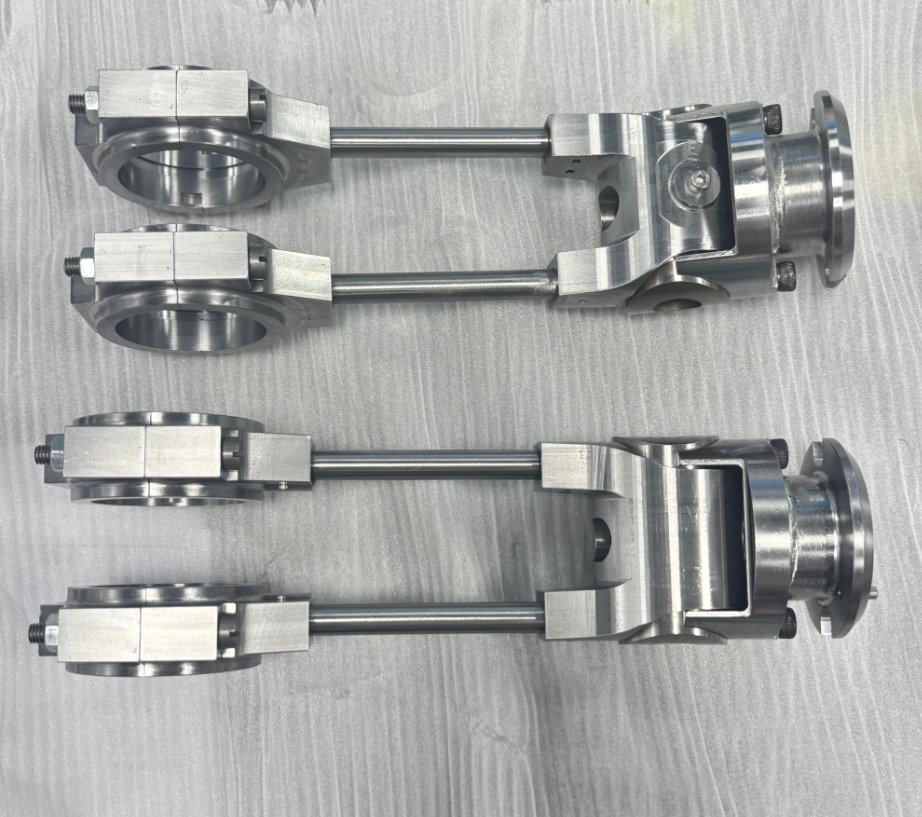
The supplied photograph shows two metal linkage assemblies with paired rods, split clamping blocks, central connection features, and circular mounting flanges. It illustrates why a robot arm component project needs coordinated interface control: the paired clamp positions, rod spacing, and flange orientation must match the assembly design.
For an aluminum version of this type of assembly, the manufacturing review would establish the alloy, locate the critical bores from common datums, and define the required fit between the clamp blocks and mating rods. Inspection would then check those dimensions against the drawing. The photograph alone does not establish the material of every part, a tolerance value, or the performance of the completed mechanism.
Surface Finishing and Inspection
Anodizing can provide a protective finish for suitable aluminum parts, with color options depending on the specification. Finishing requirements should identify any bores, threads, or locating faces that need masking or dimensional compensation. Coating buildup can affect mating dimensions, so the drawing should define whether critical dimensions apply before or after finishing.
An inspection plan can include material verification, first-article dimensional checks, CMM measurement of specified feature relationships, thread checks, and visual inspection for burrs or surface damage. Trial assembly may be included when mating parts are available and the scope is agreed.
From Prototype to Repeat Production
Prototype machining helps confirm the fit of aluminum robotic arm components before a larger order. Once the design is approved, controlled drawing revisions, consistent material specifications, and repeatable inspection criteria help maintain batch consistency. Any changes to alloy, surface finish, or critical dimensions should be reviewed before production.
Request a Quote for Custom Aluminum Robot Arm Components
HKAA supports custom CNC aluminum machining for arm links, connection blocks, mounting flanges, and related automation components. Browse our CNC aluminum robotics parts or send your project details for manufacturing review.
For a useful quotation, provide a 3D model and 2D drawing, alloy and temper, order quantity, critical tolerances, surface finish, and inspection requirements. If you need assembled components, also specify the mating parts and assembly scope. Contact HKAA for your custom precision robot arm aluminum components quote.